
Today, we want to take a look at a tree that many of you have probably come across during your time here in Buffalo and Western New York. While spruce trees are not a very abundant tree in this region in comparison to other tree types, it still feels important to talk about them. Spruce trees are widely known for being located in elevated forest regions, like in mountains, for example and not nearly as much in populated areas around your home or place of business. There are still times when someone might get a spruce tree for their yard or as a Christmas tree, for example. Regardless of the context, this is important!
In this blog, we will break down a complete guide to the spruce tree from landscaping care, its growth, common problems like diseases, and more.
Understanding Spruce Trees in Buffalo and Western New York
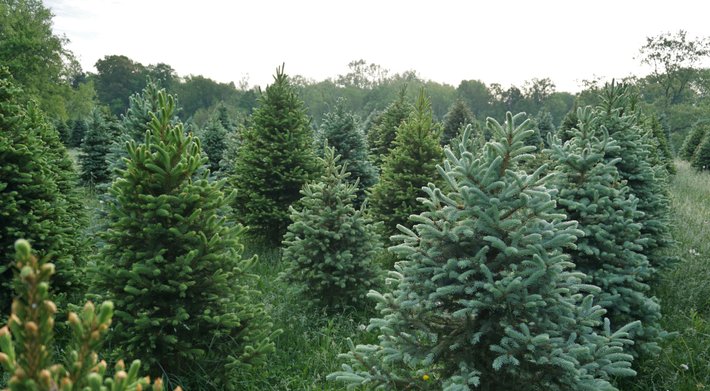
Photo Credit: https://sprucechristmastrees.co.uk/tree-types
As we just noted, this type of tree is not all too common in Buffalo and Western New York, at least in its surroundings. You won’t find it too often in public areas around infrastructure or in urban and suburban areas. Spruce trees across Western New York are found in popular varieties like the Norway spruce tree and Colorado blue spruce, variants of the tree that align well with Buffalo and Western New York’s long winters and more moderate summers.
These trees prefer full sun, meaning they prosper more in the summer; they work better with slightly acidic soil, and if there’s consistent moisture with proper drainage (1-3 inches per hour), then they will survive. While they are an adaptable tree, they perform best in cooler, moister environments. Basically, any conditions that you might find near a big body of water, like Lake Erie, which Buffalo and Western New York are closest to. Urban landscapes in Buffalo can introduce stress factors such as compacted soil, road salt, and limited airflow that could negatively affect a spruce tree.
Spruce Trees Lifespan and Growth Patterns
Spruce trees are slow to moderate growers, though some species, like the Norway spruce, can grow up to 2-3 feet per year under ideal conditions. Mature trees can reach heights of 60-100 feet. Healthy growth depends on proper planting and early care; if that’s something you want, finding your own spruce tree to plant. They require adequate spacing to ensure airflow and prevent disease. Their shallow root systems also mean they benefit from mulching and protection from soil compaction.
In Western New York, because there are such massive seasonal shifts with the weather and temperature changes, this plays a big role in their growth. Cold winters encourage these trees to stick to a dormancy plan, while the region’s wet springs and humid summers can accelerate both growth and disease activity. Diseases that could be a major hindrance if not treated properly.
Common Spruce Tree Diseases
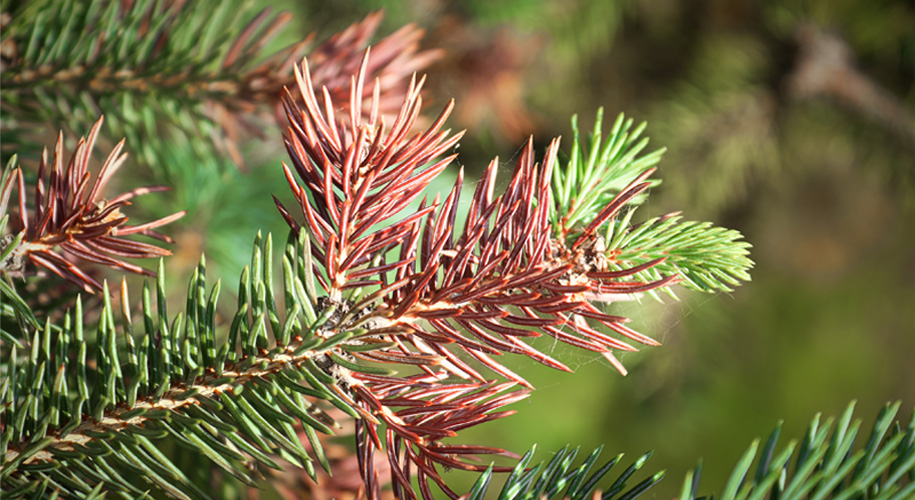
Photo Credit: https://titantreecare.org/arborism/whats-wrong-with-my-spruce-identifying-needle-cast/
So let’s dive more into those diseases! The region’s humidity at this time of the year is a cause for the fungal diseases you see on a lot of trees, amongst other causes that are inflicted upon them. What’s known as Rhizosphaera Needle Cast is a disease that causes the needles on a spruce tree to turn purple or brown and drop prematurely. Lots of tree diseases carry the same process, where the parts of a tree that make it look like a tree will die off first.
Then you have diseases like Cytospora Canker, which affects mature spruce trees. It can cause branch dieback and visible resin oozing. Dieback is the progressive death of twigs and branches, as we just mentioned. Root rot is a disease that lots of trees suffer from, not just spruce trees. It’s when overly wet soil damages the roots, and it could kill a spruce tree quickly if not addressed as soon as possible. Not to mention that pests like spider mites or bark beetles could worsen those conditions that the diseases impose on a tree.
If you’re curious to learn more about these trees or need help looking for a good spruce tree for next Christmas, we’ve got you covered. One of our primary goals in 2026 is to specialize in promoting and educating people on tree growth and tree preservation. This is one of the ways we do it, because these trees are very important to the environment. Please reach out to us through our contact form if you have any questions. We can’t wait to help!
Spruce Tree FAQ
What are the essential spruce tree care tips that I should know?
To maintain a healthy spruce tree, focus on these core practices:
- A spruce tree needs consistent moisture. If a dry spell happens, drought can put stress on the tree, weaken it, and make it vulnerable to diseases, so always be sure to water it properly.
- Trees need mulch, and a spruce tree can work with a nice 3-4 inch layer of organic mulch that will regulate its temperature, protect the soil, and maintain the moisture from watering it.
- Tree pruning is one of Bradly Tree’s specialties and an aspect of tree care that must be implemented every now and then. It will remove dead and diseased branches and prevent them from spreading. Give us a call if your tree needs that done!