Hemlock Woolly Adelgid is a tree pest/disease that has found its way through New York State. Originating in Japan, the pest has been responsible for killing hundreds of thousands of hemlock trees in the Northeast.
Spring is when we will find out how bad HWA might be this year, so today we want to spend some time educating you on what the disease is and how it functions. It’s also a good time to remind you about a blog about Hemlock Trees from last spring, and some of the other important things to look out for with them.
In this blog, we will break down how to identify and treat the Hemlock Woolly Adelgid, how it affects Hemlock trees, and when in the seasons it’s most abundant.
First, A Major Update About Hemlock Woolly Adelgid
We want to start with a major update concerning Hemlock trees here in New York State. Back in mid March of this year, officials from the New York State Department of Environmental Conservation (DEC) confirmed that a specialized predator beetle, called the Laricobius nigrinus, is helping to fend off the woolly adelgid disease, specifically in the lower Hudson Valley area.
These beetles are starting to spread across the state, with populations detected up to 15 miles from original release sites, signaling that the beetles are sustaining without constant human intervention.
This is a great step forward to help protect the hemlock tree population, which is vital for wildlife habitat and ecosystem stability in New York State. We recommend you give this Hemlock overview a read to understand why this experiment with the beetles was conducted. The establishment of this predator beetle suggests that long-term control could help reduce the spread of Woolly Adelgid and preserve hemlock trees across New York.
A Guide to Hemlock Woolly Adelgid on Your Trees
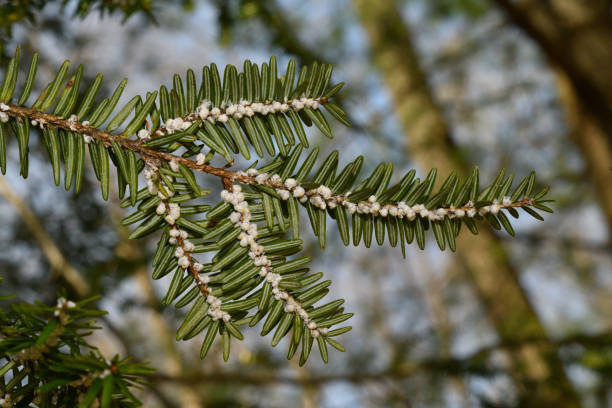
Photo Credit: Robert Winkler (https://www.istockphoto.com/photo/hemlock-woolly-adelgid-infestation-on-underside-of-eastern-hemlock-branch-gm1314862384-402989462)
Like many other plant healthcare problems, it all starts with an insect. This pest feeds on the sap of a hemlock tree, weakening it over time, which can lead to death within several years if left untreated. As you see in the picture above, it focuses on the twigs near where the needles are attached.
Early Detection and Identification of Hemlock Woolly Adelgid
An early sign of detection is when you see a yellow color on the needles, if there’s needle loss, or branches and limbs starting to show death from dieback, which stems from the tip down to the base of the branch. We talk about this in the old blog we mentioned at the beginning!
You might see a white substance of sorts growing out, and that is one of your best-case scenarios for identifying it. These masses that look like cotton balls are called ovisacs. They contain eggs, and this would be one of the most visible signs of the disease producing at a higher rate. Some symptoms of this disease include needle loss, thinning foliage, and overall decline in health. Because these white sacs are easiest to spot when foliage is less dense, winter would be the best time to inspect trees for the pest.
Is There Any Way to Prevent Hemlock Woolly Adelgid?
Once infestation occurs, treatment for HWA by a certified arborist is vital. It’s going to be difficult to prevent the pest from reaching your trees. There are some steps you can take to minimize the impact that HWA can have on your hemlocks. There are systemic treatments that can help to prevent and control HWA. Practicing good plant healthcare habits and providing a healthy schedule of care for the hemlock can also protect it from infestation. Practicing regular trimming and pruning can help create a stronger tree, which can help the tree to protect itself.
Avoid compacting the soil around hemlocks, and be careful of wounding trees with lawn equipment or snowplows, etc. You should avoid fertilizing a tree infested with HWA as it just helps the adelgids to produce more offspring. Any transportation of infested trees or wood can also lead to spread of the adelgids to other hemlocks, and other plants.
When is the Adelgid Most Active?
The timing of the adelgid’s life cycle can be unusual when you compare it to other insect-based tree diseases. Hemlock Woolly Adelgid is most active during the cooler months, which would be the late fall through early spring. We are now in early springtime, which makes it more important to talk about now than at any other time in the year. Cold weather could also play a role in lessening the impact that HWA has on our WNY hemlocks this year.
These insects feed on sap, which is the very thing that Hemlock trees need to start growing, and we want to make sure that stops. Hemlock trees need the spring to help grow and prepare for the next winter season. Winter activity in general allows these pests to avoid many natural predators and continue damaging trees when the growth process is needed most. Once those warmer months take effect, you’ll notice the impact more clearly.
We are crossing our fingers that cold weather has helped it spread a little more than usual, which is why we are making this blog and why we want you to reach out to us if you notice this disease on your Hemlock trees.
If you have any other questions regarding Woolly Adelgid or how we can take care of it, give us a call, reach out through our contact form to schedule a time where we can come out and take a look, and we will get back to you as soon as possible!
Hemlock Woolly Adelgid FAQ
How do I treat the Hemlock Woolly Adelgid disease on my trees?
It is advised to hire an arborist to treat HWA. There are a couple of ways an arborist can treat Hemlock Woolly Adelgid, but one of them is through sprays. These treatments are applied through soil drenches or direct trunk injections. It will kill the pests on first contact. You will want to apply this treatment between spring and fall when the ground is not frozen, and protection can last several years, depending on the method you use to treat it. We have a section of our website that deals with products we use in order to keep your plants and trees healthy and thriving. Give it a read, and call us if you have any questions!